Nadene Goldfoot
Andi Ziegelman nee Alpert, co founder of Halpern & Branches on Family Tree DNA, had written," My particular interest comes from having an ancestor, Nachum Eliyahu Halpern, who claimed descent from Jehiel Heilperin, a great talmudist from Minsk, Belarus. There are other HALPERN who descend from rabbinic families of the Russian Empire, as well as others who simply adopted the surname in the 19th century when it became necessary to chose a name.
So I am looking to dissect the different HALPERN groups to see which, if any, share a common ancestry.
As of now (August of 2009), it looks as if my HALPERN family does NOT descend from the large HEILPERIN descended from Zebulun HEILPERIN, at least not via a direct male line. If I do descend from Rabbi Jehiel mentioned above, its likely also through a female line that later adopted the surname (or, alternatively, I either do not relate to Jehiel at all, OR Jehiel does not descend from this greater Heilperin family, as documented by Rabbi Meir Wunder.)"
https://www.jewishgen.org/rabbinic/journal/wunder.htm
The Reliability of Genealogical Research
in Modern Rabbinic Literature
 |
| Rabbinic literature deals very sparsely with genealogical research, a fact that is quite surprising, considering the importance that is ascribed to family yuchsin (lineage). | |
|
Rabbinic literature deals very sparsely with genealogical research, a fact that is quite surprising, considering the importance that is ascribed to family yuchsin (lineage). In the Tanach (Bible) almost all of Chronicles I deals with yuchsin, and the seeming contradictions to the genealogical facts recorded in the Torah and the Prophets are explained away by the classic commentaries.
Toward the end of the Babylonian Exile, we find Ezra the Scribe clarifying the yuchsin of the returnees to Eretz Yisrael, so that the fourth chapter in Tractate Kiddushin of the Babylonian Talmud begins, “The people who came up from Babylon were of ten types of familial background.” It also states in the same chapter (70:2), “The Almighty's Presence dwells only among families of pure lineage in the Nation Israel.” True that in Ezra's time there were still prophets able to make the clarification through prophesy, but even lacking this, there were live eyewitnesses among the older people who remembered and could identify individuals in the relatively short historical span of 70 years. (beginning of long essay).
Dan Rottenberg in his book, Finding Our Fathers, tells us that Heilperin has many derivatives: Halpern, Heilbronn, Heilbroner, Heilperin, Heilpern, Heilborn, Hallperin, Helpern, Alpron,Alpern, Galpern, Heilprin, Galperin, Halper, Helpern:
He explains that it is a German name derived from the town of Heilbronn in Wurttemberg. All Jews with variations of this name are not necessarily related. Many Jews of Austria, Germany and Russia indiscriminately assumed these names when ordered to take family names in about 1800. However, there are 4 distinct branches of the Heilprin name. JE )Jewish Encyclopedia) has charts for 3 branches: many Heilprins in Russia claimed in 1900, descent from the 4th branch.
The oldest branch dates back to Zebulon Heilprin: 16th century, whose son, Moses of Brest-Litovek, was the father-in-law of Samuel Edels.
Another branch descends from Lithuanian rabbi, Jehiel Heilprin (1660-1746), a descendant of Solomon Luria, who traced his genealogy back through RASHI (1040-1105) which is a very important fact.
A Heilprin branch is also related to the BAAL SHEM TOV, founder of Hasidism. There evidently are many biographies in JE, most from Poland, Russia and Germany.
Also, see EJ article on Abraham ben Hayyim of Lublin, Poland who died in 1762, grandson of Isser, whose son married Fortis.
CAJ has a Heilprin family tree. LBl has a Heilbrunn family tree beginning 1683. LBIS has notes of a Heilbron family from Posen. CAJ has Halpern family records. Relationships to other prominent rabbinical families can be traced in Anaf Ex Aboth, by Samiuel Kahan, and Da'at Kodoshim, by Israel Eisenstadt.
Relatives include: Katzenellenbogen, Hurwitz, Horovitz, Jaffe, Wahl, Hen-Nigson, Ornstein, Kaminski, Epstein and Raphael.
Also see JE article on Pinsk, Russia, where Samuel Halpern was rabbi."
"This project has as its goal the expanding the Autosomal DNA (atDNA) Family Segments, for each branch – and some sub-branches – of the greater Halpern family. These segments have been made through the use of the triangulation software utility on the web site, GedMatch.com.
If you have an unsubstantiated oral tradition of Halpern descent, or if you see a large number of Halperns on your FamilyFinder match list, and you thus suspect that you may be a Halpern, this project is for you. All you need to do is join our project and then upload the RAW DATA and X FILES from your FamilyFinder Autosomal DNA test to the web site, GedMatch.com, and inform the project’s administrators that you have done so. If you have difficulty carrying out the task, just ask the project’s administrators for help. Once on GedMatch, this project’s administrators will try to triangulate “suspected Halperns” on Halpern atDNA Family Segments. If successful, such triangulations will be a very good indication to this project’s members, of belonging to the Halpern family.
The main branches of the Halpern family are Halpern, Alperovich, Wertheim/er Rubenstein and Guggenheim. The Halpern branch breaks down into the Heilbronner, Heilbron, Heilborn, Heilprin, Halperin, Hellman/Hillman, etc. sub-branches.
The Alperovich branch apparently is a sub-branch of the Zevulun Eliezer Heilprin branch. The Wertheim/er branch is one of two sub-branches of the family tree of R. Isaac of Worms; the second sub-branch of R. Isaac’s family tree is the Rubenstein/Rubinstein branch. And some descendants of R. Isaac bore the Heilprin/Halpern surname. The Guggenheim branch is connected by Y DNA to the R. Zevulun Eliezer Heilprin sub-branch; the Guggenheims never went by the Heilprin/Halpern surname." To know more, see the rest of the page of Halpern & Branches.
I want to know more about Rabbi Meir Wunder ! I found http://www.jgaliciabukovina.net/134921/worker/rabbi-meir-wunder. He is a historian, Author of "Meori Galicia: The Encyclopedia of Galician Rabbies and Scholars".
Meorei Galicia: Encyclopedia of Galician Sages by rabbi Meir Wunder is one of the most extensive and reliable sources of rabbinical genealogy written in the twentieth century. Its six volumes, published from 1987 contain extensively detailed genealogies of Galician rabbinical families, arranged alphabetically by surname according to the Hebrew alphabet. For prominent rabbis of each family biographical material is included, in particular, rabbinical compositions, responsa correspondence, and photographs.
Now you can enjoy a free access to a limited edition of this collection with a minimal charge for access to the full edition. We invite you to a unique insight into the Jewish world of Galicia. To register click the big red button on top.
He's listed on a Chabad page. https://www.chabad.org/search/keyword_cdo/kid/23121/jewish/Meir-Wunder.htm. Rabbi Meir Wunder is the founder and director of the Center for Torah Libraries. He was interviewed in his home in Jerusalem in February of 2011.
Posted on May 5, 2007 by tribetracing
The May 14 meeting of the Israel Genealogical Society’s Tel Aviv branch features Rabbi Meir Wunder on new possibilities in contemporary genealogical research of rabbinical families. His talk will be in Hebrew.
Born in Haifa, Wunder studied at the Paniewicz Yeshiva (Bnei Brak) and at Hebrew University’s School for Librarians (Jerusalem). For 30 years he headed the National Library’s Legal Deposit. Wunder has authored many books and articles, including the seven-volume Meorei Galicia: Encyclopedia Lekhakhmei Galicia (Encyclopedia of Galician Sages).
The program will begin at 7 p.m., at Beit Hatanach, 16 Rothschild Blvd., TelAviv. The library will be open from 6-7 p.m. Non-members, NIS 20.
Meorei Galicia: Encyclopedia of Galician Sages by rabbi Meir Wunder is one of the most extensive and reliable sources of rabbinical genealogy written in the twentieth century. Its six volumes, published from 1987 contain extensively detailed genealogies of Galician rabbinical families, arranged alphabetically by surname according to the Hebrew alphabet. For prominent rabbis of each family biographical material is included, in particular, rabbinical compositions, responsa correspondence, and photographs.
Resource:
https://www.jewishgen.org/rabbinic/journal/wunder.htm
Labels: Baal Shem Tov, dna, family trees, Germany, Halpern & Braanches, Poland, Rabbi Meir Wunder, Russia
Nadene Goldfoot
The Polish–Lithuanian Commonwealth, formally known as the Kingdom of Poland and the Grand Duchy of Lithuania, and, after 1791, the Commonwealth of Poland, was a country and bi-federation of Poland and Lithuania ruled by a common monarch in real union, who was both King of Poland and Grand Duke of Lithuania.(Many of the people we have matched by DNA have ancestors from Ukraine or Poland).
My 4th paternal ggggrandfather was Iankel/ Yankel ben Abram Goldfus born Bet. 1768 - 1774 in Telsiai, Lithuania. His father, our 5th, was Abram Goldfus, b: between 1750-1752 in Telsiai, Lithuania, the era of the Baal Shem Tov.
Baal Shem Tov (הבעל שם טוב in Hebrew) (1698–1760), considered to be the founder of Hasidic Judaism;came from this place.
In this time of mysticism and overly formal Rabbinism came the teachings of Israel ben Eliezer, known as the Baal Shem Tov, or BeShT, (1698–1760), which had a profound effect on the Jews of Eastern Europe and Poland in particular. His disciples taught and encouraged the new fervent brand of Judaism based on Kabbalah known as Hasidism. The rise of Hasidic Judaism within Poland's borders and beyond had a great influence on the rise of Haredi Judaism all over the world, with a continuous influence through its many Hasidic dynasties including those of Chabad-Lubavitch, Aleksander, Bobov, Ger, Nadvorna, among others.
"Zaporozhian Cossacks write to the Sultan of Turkey" by Ilya Repin (1844–1930)
Meeting of Khmelnytsky with Tuhaj Bej by Juliusz KossakBetween 1648 and 1656, tens of thousands of Jews—given the lack of reliable data, it is impossible to establish more accurate figures—were killed by the rebels, and to this day the Khmelnytsky uprising is considered by Jews to be one of the most traumatic events in their history.

A major rebellion of self-governed Ukrainian Cossacks inhabiting south-eastern borderlands of the Commonwealth rioted against Polish and Catholic oppression of Orthodox Ukraine in 1648, in what came to be known as the Khmelnytsky Uprising. It resulted in a Ukrainian request, under the terms of the Treaty of Pereyaslav, for protection by the Russian Tsar. In 1651, in the face of a growing threat from Poland, and forsaken by his Tatar allies, Khmelnytsky asked the Tsar to incorporate Ukraine as an autonomous duchy under Russian protection. Russian annexation of Zaporizhian Ukraine gradually supplanted Polish influence in that part of Europe. In the years following, Polish settlers, nobles, Catholics and Jews became the victims of retaliation massacres instigated by the Cossacks in their dominions.

My paternal Bubba, Zlata (Addie/Hattie/Ettie) Jermulowske, was born on January 11, 1886 in Lazdijai/ Lozdzieje, Alytraus, Suwalki /Zuwalta", Lithuania which had been taken over by Poland. Bubbie was prouder of being a Litvak than Polish, so she said. She really didn't speak English, only Yiddish. She didn't read or write in any language, either.
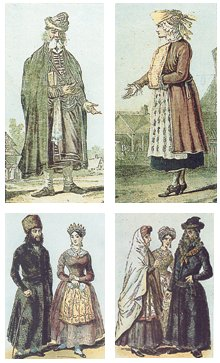
Jewish dress in 17th (top) and 18th centuriesThis Commonwealth was one of the largest and most populous countries of 16th to 17th-century Europe. At its largest territorial extent, in the early 17th century, the Commonwealth covered almost 1,000,000 square kilometres (400,000 sq mi) and as of 1618 sustained a multi-ethnic population of almost 12 million. Polish and Latin were the two co-official languages. By comparison, the state of Oregon is only 98,466 mi.²The commonwealth was about 4 Oregons put together.
Under "languages, it said, "
- Hebrew – off. recog.;and Aramaic used by Jews for religious, scholarly, and legal matters.
- Yiddish – not officially recognized; used by Jews in their daily life
According to some sources, about three-quarters of all Jews lived in Poland by the middle of the 16th century. In the 16h and 17th centuries, Poland welcomed Jewish immigrants from Italy, as well as Sephardi Jews and Romaniote Jews migrating there from the Ottoman Empire. Arabic-speaking Mizrahi Jews and Persian Jews also migrated to Poland during this time Still, as Poland regained independence in the aftermath of World War I of 1918, it was the center of the European Jewish world with one of the world's largest Jewish communities of over 3 million. Antisemitism was a growing problem throughout Europe in those years, from both the political establishment and the general population.
On the eve of the German occupation of Poland in 1939, 3.3 million Jews lived there. At the end of the war, approximately 380,000 Polish Jews remained alive, the rest having been murdered, mostly in the ghettos and the six death camps: Chelmo, Belzec, Sobibor, Treblinka, Majdanek and Auschwitz-Birkenau.
June 1941 marked the beginning of a dark episode in Lithuania’s history: amid World War II and the occupation of the country by Nazi Germany, on or about June 23 the slaughter of nearly the entire Jewish population of Lithuania began. Lithuanians had waged anti-Jewish mob violence even before the German occupation. When Nazi Einsatzgruppen (mobile killing units) began the large-scale murder of Lithuania’s Jews in late June, other Lithuanians were on hand to aid and abet them. The first pogrom may have been that of Gargždai, near the German border, where some 800 Jews were killed on June 23 and 24. In one of the largest massacres, more than 70,000 people were killed at Paneriai (Ponary), outside Vilnius, that summer. We are so fortunate that Bubbie came to the USA when she did on May 6, 1903, before WWI and before the Holocaust! Jews lived in Poland for 800 years before the Nazi occupation. On the eve of the occupation 3.3 million Jews lived in Poland – more than any other country in Europe. Their percentage among the general population – about 10% – was also the highest in Europe. Right now, Jews make up 2% of the USA population, and we're again confronting anti-Semitism that's more than usual. Blacks make up 13%.
Resource:
https://en.wikipedia.org/wiki/Polish%E2%80%93Lithuanian_Commonwealth
https://en.wikipedia.org/wiki/History_of_the_Jews_in_Poland
https://jewishbubba.blogspot.com/2015/12/our-famous-rabbis-and-gifts-they.html
https://jewishbubba.blogspot.com/2015/05/two-aspects-of-orthodox-judaism-chabad.html
https://www.yadvashem.org/holocaust/about/fate-of-jews/poland.html#narrative_info
https://en.wikipedia.org/wiki/Khmelnytsky_Uprising#:~:text=Between%201648%20and%201656%2C%20tens,traumatic%20events%20in%20their%20history.
Labels: Abram Goldfus, Baal Shem Tov, map, Yankel Goldfus, Zlata Jermulowske
Nadene Goldfoot
Connecting to Rabbi Wertheimer was found through triangulation on the part of the leaders of Halpern and Branches on Family Tree DNA.
What was found that surprised all was that we had
no matches from the
Zevulun Eliezer Heilprin line which others seemed to have. This Heilprin was born in 1510 and was the son of a Hilborn.
2 This is the oldest branch and dates back to Zebulon Heilprin-16th century, whose son, Moses of Brest-Litovsk was the father-in-law of Samuel Edels. It seems that
Zevulun Eliezer Heilprin's genealogy comes to us in Hebrew from
Meir Wunder's Elef Margaliot, - He traces his ancestry back to Yitzchak of Dampierre AKA the R"I (ca. 1120 - 1200).
This is the Yitzchak, "Isaac ben Samuel the Elder (c. 1115 – c. 1184), who was also known as the Ri ha-Zaken, and was a French tosafist and Biblical commentator. He flourished at Ramerupt and Dampierre, France in the twelfth century. He's in my encyclopedia! He was also called Isaac ha-Zaken which means the Senior. Isaac succeeded his uncle Rabbenu Tam as head of the Ramerupt yeshivah and later settled in Dampierre. His pupils quoted his tosaphot and his responsa were scattered through many contemporary works. He wrote a commentary on the Pentateuch but it did not survive. He was interested in mysticism and was in touch with the kabbalists of southern France. His scholarly son, Elhanan, was martyred in his lifetime. (Rabbi Elhanan was married to Unknown whose father was Rabbi Yitzhak Hazaken Hehasid Kalonymus. Elhanan died in the 1st Crusades of 1096l. His wife's mother was a descendant of Rabbi Meshullelm Hadgadol Kalonymus of Lucca, Italy and lived from 900 to 976.

On his father's side,
Isaac was a grandson of R.
Simhah ben Samuel of Vitry, author of the
Maḥzor Vitry; on his mother's side he was a nephew of
Rabbeinu Tam, of
Rashbam, and of
Isaac ben Meir (RiBaM), a great-grandson of Rashi, and
a relative of R. Eleazar of Worms. He is often quoted as R. Isaac of Dampierre but it seems that he lived first at
Ramerupt, where his maternal grandfather resided. It was also at Ramerupt that he studied under his uncle R. Tam after the latter had gone to
Troyes. Isaac ben Samuel directed his school.
Isaac settled at Dampierre later, and founded there a flourishing and well-attended school (
Or Zarua, i. 126). It is said that he had sixty pupils, each of whom, besides being generally well grounded in
Talmud, knew an entire treatise by heart, so that the whole Talmud was stored in the memories of his pupils As he lived under
Philip Augustus, at whose hands the
Jews suffered much, Isaac prohibited the buying of confiscated Jewish property, and ordered that any so bought be restored to its original owner. A particular interest attaches to one of his responsa, in which he relies on the oral testimony of his aunt, the wife of R. Isaac b. Meïr, and on that of the
wife of R. Eleazar of Worms, a great-granddaughter of Rashi
He died, according to
Heinrich Graetz , about 1200; but according to
Henri Gross between 1185 and 1195; and as he is known to have reached an advanced age, Gross supposes that he was not born later than 1115. On the other hand, Michael (
Or ha-Ḥayyim says that as Isaac ben Samuel was spoken of as "the sainted master" a term generally given to
martyrs, he may have been killed at the same time as his son Elhanan (1184).
From Geni: another way of putting it:
HaRav Yitzhak Ben Shmuel Hazaken of Dampierre de Vitry, [baal HATOSAFOT] MP
| Birth: | 1120
Ramerupt, Champagne-Ardenne, France |
|---|
| Death: | 1189 (69)
Dampierre, Aube, Champagne-Ardenne, France |
|---|
| Immediate Family: |
|
|---|
This meant that our Halperns come from a different line. All the 11 or so Halperns on our list come from the non-Zevulun Eliezer Heilprin lines and this was an important find. "
Halpern is one of the most widespread Jewish names. It is derived from the city of Heilbronn in Wurttemburg, Germany, where it was first assumed about four hundred years ago. There are many variations and some are: Heilpern, Halper, Helpern, Heilbrun, Heilbronner, Heilprun, Alpron, Alpern, Galpern and Halprin.
Source: Kaganoff, B. C. (1977). A dictionary of Jewish names and their history. New York: Schocken Books.
In the book, FINDING OUR FATHERS BY DAN ROTTENBERG, he lists:
1.Halper--See Heilprin
2. Halperin--See Heilprin
3. Halpern---See Heilprin
4. Heilprin (also Halpern, Heilbronn, Heilbrunn, Heilperin, Heilbron, Heilbroner, Heilperin, Heilpern, Heilborn, Halperin, Hellpern, Alpron, Galpern, Heilprun, Galperin, Halper, Helpern.
It's a German name derived from the town of Heilbronn in Wurttemberg. All Jews with variation of this name are not necessarily related; many Jews of Austria, Germany and Russia indiscriminately assumed these names when ordered to take family names in about 1800. There are 4 branches of the Heilprin name: Jewish Encyclopedia has charts for 3 branches.
 |
Heilprin Tree The genealogy of a third branch is that made by Belinson of the family of Jehiel Hirsch Heilprin, who went from Brody in 1821 to Odessa, where he was dayyan ...
|
3. Another branch comes from the Lithuanian Rabbi Jehiel Heilprin (1660-1746), a descendant of Solomon Luria, who traced his genealogy back through Rashi (1040-1105). Jehiel Ben Solomon Heilprin was born about 1660 in Russia. He was a scholar. He was rabbi at Glusk in White Russia (Belarus) and from 1711 in Minsk (Belarus). His best-known work was Seder ha-Dorot comprising a chronology down to 1696, an alphabetical list of tannaim and amoraim, and a catalog of post-talmudic Hebrew authors and books. He had rabbinical knowledge and also a wide secular education and was a student of Kabbalah. He traced his genealogy back through Rashi to the tanna Johanan Ha Sandlar, the shoemaker was born in Alexandria in the 2nd century.
 |
| Rabbi Akiva |
He was a Palestinian tanna and a pupil of Rabbi Akiva. He survived the Hadrianic persecutions and was a teacher of the Torah. Ben Joseph Akiva c: 50-135 was a tanna. He was of humble origin and remained undeducated until age 40. He was later regarded as the greatest scholar of his time.
 |
| Baal Shem Tov |
4 A Heilprin branch is also related to the BAAL SHEM TOV AKA Israel Ben Eliezer (1700-1760) born in Podolia (between Ukraine and Moldova) . , founder of Hasidism. Many biographies are in Jewish Encyclopedia, most from Poland, Russia and Germany. An article in EJ on Abraham ben Hayyim of Lublin, Poland who died in 1762, a grandson of ISSER, whose son married FORTIS is suggested. CAJ has a Heilprin family tree. LBI has a Heilbrunn family tree beginning in 1683. LBIS has notes of a Heilbron family from Posen. CAJ has Halpern family records. Relationships to other prominent rabbinical families can be traced. Relatives include Katzenellenbogen, Hurwitz, Horovitz, Jaffe, Wahl, Hennigson, Ornstein, Kaminski, Epstein and Raphael. JE article on Pinsk, Russia is where Samuel Halpern was a rabbi.
. Many Heilprins in Russia claimed in 1900 descent from the 4th branch.
On our list of matches, however, almost all the Alperoviches who do connect to the Zevulun Eliezer line. This means that someone from our Halpern family married into the Alperovich family founder since 9 Alperoviches are on our list. It's another piece of important information.
The earliest I've seen is an Abram Alperovich b: 1660, place unknown.
In researching, I found a Rose Luria Halprin (1895-1978) US Zionist who was national president of Hadassah from 1932 to 1934 and then again from 1947 to 1952. From 1946 to 1968 she belonged as an executive of the Jewish Agency. In 1969 she was appointed to head the American Division of the World Jewish Congress. Besides that, she was a very pretty lady.
There were several Heilprins in my encyclopedia.
1. A
ngelo (1853-1907 US geologist, paleontologist and explorer, son of Michael Heilprin.
2.
Michael (1823-1888) was an author and journalist of Polish birth, he went to Hungary in 1842 and was appointed secretary of the Ministry of the Interior's press office in the 1848 rebellion. He then escaped abroad and in 1856 settled in the USA and taught in Jewish schools in Philadelphia and was an activist in the anti-slavery movement.
3.
Louis (1851-1912) was editor and son of Michael. He was also a writer.
JE: Jewish Encyclopedias
EJ Encyclopedia Judaica
LBI Leo Beck Institute
UJE Universal Jewish Encyclopedia
Resource:
http://www.geni.com/projects/Alperovich-Heilbrun-Heilprin-Family/1540 working on the Alperovich/Heilbrunn/Heilbrun/Heilbronner/HeilprinFamily History
http://goldfoot_genealogy.blogspot.com/2014/10/goldfoot-genealogy-from-rabbis-of-worms.html
http://www.geni.com/people/Zevulun-Eliezer-Heilprin-Hillman/6000000008368206939
https://www.blogger.com/blogger.g?blogID=7896552#editor/target=post;postID=6806184449982076448
http://www.wikitree.com/genealogy/ALPEROVICH
Finding Our Fathers by Dan Rottenberg
http://www.lbi.org/research/family-research/
https://en.wikipedia.org/wiki/Jehiel_ben_Solomon_Heilprin
Halpern & Branches Group on FTDNA
Books: TRACE YOUR ROOTS WITH DNA by Megan Smolenyak and Ann Turner...Has information from another 3rd cousin Louis Loccisano in it.
Labels: Baal Shem Tov, Jehiel Heilprin, Meshullam Kalonymos, Moses Wertheimer, Rabbi Samson Wertheimer, Yitzchak of Dampierre, Zebulun Eliezer Heilprin